
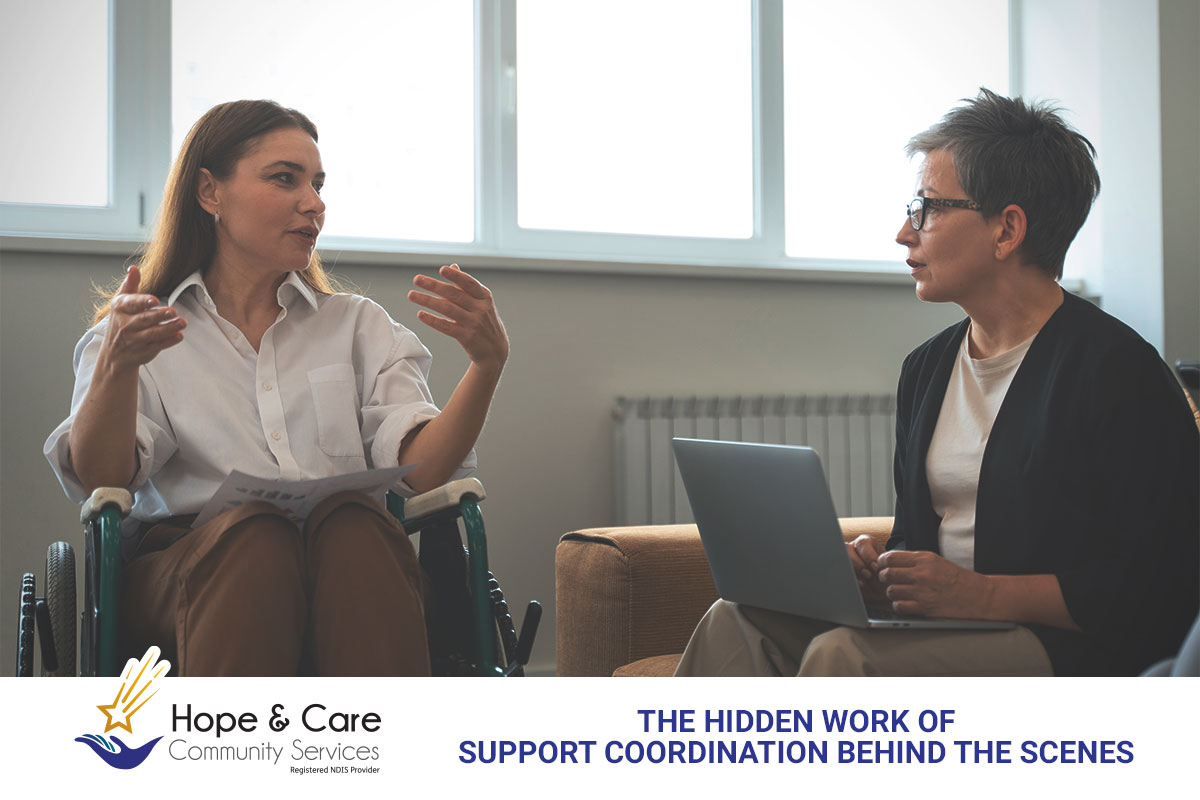
Support coordination can look invisible when it is done well. Participants may see appointments booked, providers aligned, and supports running on time. What they do not always see is the work that happens before any of that falls into place. Under NDIS guidance, a support coordinator helps a participant use their plan, choose suitable providers, connect with community and government services, and build confidence to manage supports over time.
That means support coordination is not just about referrals. It is about building a workable support system. In Brisbane, that often starts with reading the plan closely, understanding budgets, identifying goals, and spotting gaps between funded supports and daily reality. A support coordinator must turn a plan document into something practical that fits the participant’s life.
Reading the plan is only the beginning
A large part of the hidden work starts with interpretation. Support coordinators help participants understand what their funded supports can be used for, how the supports should work together, and when service agreements may be needed. This step sounds simple, but it often shapes every decision that follows. If the plan is misunderstood early, the rest of the support setup can drift off track.
Support coordination also differs from plan management. A plan manager focuses on the financial side, such as paying providers and tracking spending. A support coordinator focuses on the supports themselves. That includes how they are arranged, whether they suit the participant, and how they connect to the participant’s goals.
Matching providers takes more work than many people expect
Finding a provider is rarely the end of the job. A strong match depends on availability, location, support model, communication style, and whether the service fits the participant’s goals. The NDIS says support coordinators help participants choose the right providers for their needs, not just the first provider with an opening.
Behind the scenes, this can involve requesting quotes, comparing service options, checking service scope, arranging introductions, and negotiating service agreements. Hope & Care Community Services describes this work as helping participants obtain quotes, coordinate providers in line with goals, and negotiate the method and timing of supports. That is often the difference between a service that exists on paper and a service that works in daily life.
Good coordination keeps supports working together
Many participants use more than one provider. One may deliver personal care. Another may handle therapy. Another may support community access, behaviour support, or housing-related needs. The hidden job of support coordination is to make sure those services do not operate in isolation.
The NDIA has said support coordination should help participants connect with NDIS, mainstream, and other supports, broker services in line with participant wishes, and monitor support effectiveness. In practice, that means reducing overlap, fixing communication problems, and keeping everyone focused on the participant’s goals. When this work happens quietly in the background, participants often experience smoother routines and fewer service breakdowns.
The paperwork matters more than people think
Support coordination includes a strong admin and compliance layer. The role can involve service delivery monitoring, mandatory reporting, record keeping, and preparing information for plan reviews. The NDIA also reminds support coordinators that they have obligations around proper record keeping, conflict of interest, and appropriate use of NDIS funds.
This work is rarely visible on social media or in day-to-day conversation. Yet it protects continuity and accountability. Clear documentation helps explain what is working, what is not working, and what may need to change at review time. It also helps participants make informed decisions instead of relying on guesswork.
Support coordination also means solving problems early
Some of the most valuable work happens when something goes wrong. A provider may stop suiting the participant. A roster may break down. A support worker may not be the right fit. A participant’s needs may change quickly. Good support coordination responds before a small issue becomes a major disruption.
For more complex situations, specialist support coordination may be funded. The NDIS says this higher level of support helps participants address complex barriers, design service plans where needed, and resolve issues during crisis or high-risk periods. That makes the behind-the-scenes role even more important when support environments are unstable or complicated.
Review preparation is part of the hidden workload
Support coordination is not only about starting services. It is also about reviewing whether those services still work. Hope & Care Community Services notes that its coordinators monitor the NDIS plan and work with participants to review goals before planning meetings and later reviews. The NDIS also expects support coordinators to help participants build confidence and skills over time, not create long-term dependence where it is not needed.
That review work often includes gathering updates, identifying patterns, noting risks, and showing where supports have helped or fallen short. For Brisbane participants, this hidden preparation can make plan reviews more focused and more useful. It gives the participant a clearer story about what they need next.
Why this matters in Brisbane
Brisbane participants often manage a mix of home, community, therapy, accommodation, and capacity-building supports. That mix can become harder to coordinate as goals change or services expand. The hidden work of support coordination matters because it turns separate services into a support system that is easier to use and easier to trust. That is an inference from the official role of support coordination and from how HCCS describes coordinating providers, agreements, reporting, and goal review.
Conclusion
If you are looking for support coordination in Brisbane, Hope & Care Community Services is an Approved registered NDIS provider. Its approved registration groups include Support Coordination, Plan Management, Accommodation/Tenancy, Daily Tasks/Shared Living, Behaviour Support, Therapeutic Supports, and Specialist Disability Accommodation. On the HCCS website, readers can explore the main provider site, the services page, the Support Coordination page, the SIL / SDA Properties page, and the blog homepage for related Brisbane-focused articles. HCCS also lists Brisbane South, Brisbane North, and Brisbane South West office locations across Greenslopes, Burpengary East, and Brookwater.
Want to learn more? Read other articles :
- SIL / SDA Properties
- New Guidelines for the Short Term Respite – Formerly Known as Short Term Accommodation (STA) in Brisbane
- SDA vs SIL: Understanding the Difference
- Change in NDIS SIL: What the New Reforms Means
HCCS is a registered NDIS provider. Learn more about our services.
♥ We are available in Brisbane! – Our team is just a call away!